
What Is a Steel Deck Profile?
A steel deck profile is the cross-sectional shape of the sheet. This cross-section includes ribs or flutes that repeat across the sheet width and continue along the sheet length.
In simple terms, when you look at the cut edge of a steel deck sheet, the up-and-down shape of the ribs is the sheet profile. This shape may be trapezoidal, shallow, deep, dovetail or a more specialized form.
Therefore, when we talk about different types of steel deck profiles, we do not mean only a trade name or product model. We mean real differences in cross-sectional shape, rib spacing, rib depth and the arrangement of different parts of the sheet.
Why Is It Important to Know Different Steel Deck Profiles?
Understanding different steel deck profiles is important because each profile creates different technical and installation conditions. Two sheets may have the same thickness, but if their pitch, depth or rib shape is different, they will not behave the same in a floor system.
The profile type can affect concrete consumption, possible span conditions, how the sheet sits on beams, available space for shear stud welding, effective cover width, sheet overlap and the sheet’s performance as permanent formwork during concreting.
For this reason, steel deck sheets should not be selected only with descriptions such as “0.9 mm sheet” or “1 mm sheet.” Thickness is important, but without understanding the profile, the selection is not complete or accurate.
What Is the Difference Between Pitch and Depth?
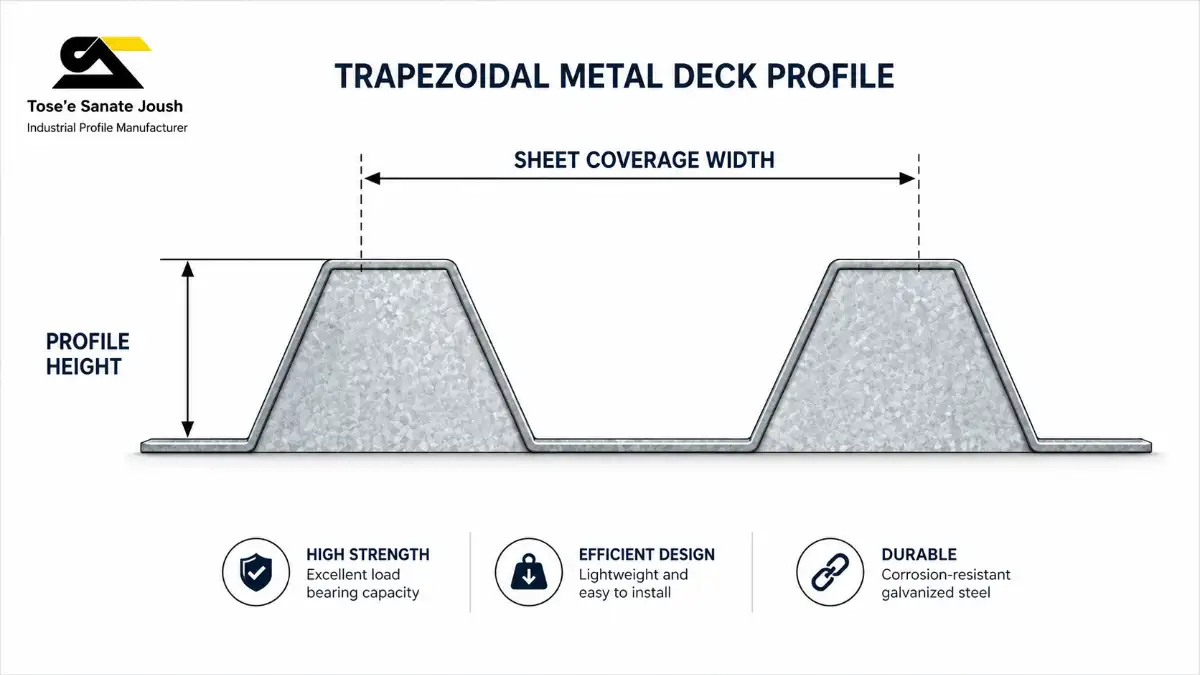
One of the most important points in reviewing steel deck profiles is understanding the difference between pitch and depth. These two terms are sometimes confused in site conversations, but technically they are completely different.
Sheet pitch is the horizontal repeating distance of the ribs. If the distance is measured from the centre of one rib to the centre of the next similar rib, the result is the pitch of the sheet.
Profile depth or rib height is the vertical distance between the lowest and highest parts of the rib. This number shows how high or deep the rib is in the cross-section.
For example, two profiles may have the same pitch, but one may have a greater depth than the other. Two sheets may also have the same depth but different rib spacing or pitch.
For a more detailed explanation of how to measure this dimension, read the article on steel deck pitch.
Difference Between Pitch, Depth, Thickness and Cover Width
To compare different steel deck profiles, several key properties should be checked separately. Confusing these dimensions can cause errors in ordering, quantity take-off, sheet inspection and even shear stud layout.
Property | Definition | Measurement Direction | Main Use |
Sheet pitch | Distance between two similar repeating ribs | Horizontal | Identifying rib spacing and layout |
Profile depth | Distance between the lowest and highest parts of the rib | Vertical | Affects stiffness and cross-sectional shape |
Sheet thickness | Thickness of the steel sheet itself | Perpendicular to the sheet surface | Affects weight, installation and sheet stability |
Top flange width | Width of the flat upper part of the rib | Horizontal | Affects bearing, concrete shape and detailing |
Valley width | Width of the lower part between ribs | Horizontal | Affects concrete volume and profile geometry |
Effective cover width | Width covered by each panel after overlap | Panel width | Used for quantity take-off and sheet count |
When selecting a steel deck sheet, these values should be reviewed separately. For example, two sheets with the same thickness may behave differently because of differences in depth or pitch. This topic is explained separately in the article on steel deck sheet thickness.
Types of Steel Deck Profiles by Cross-Sectional Shape
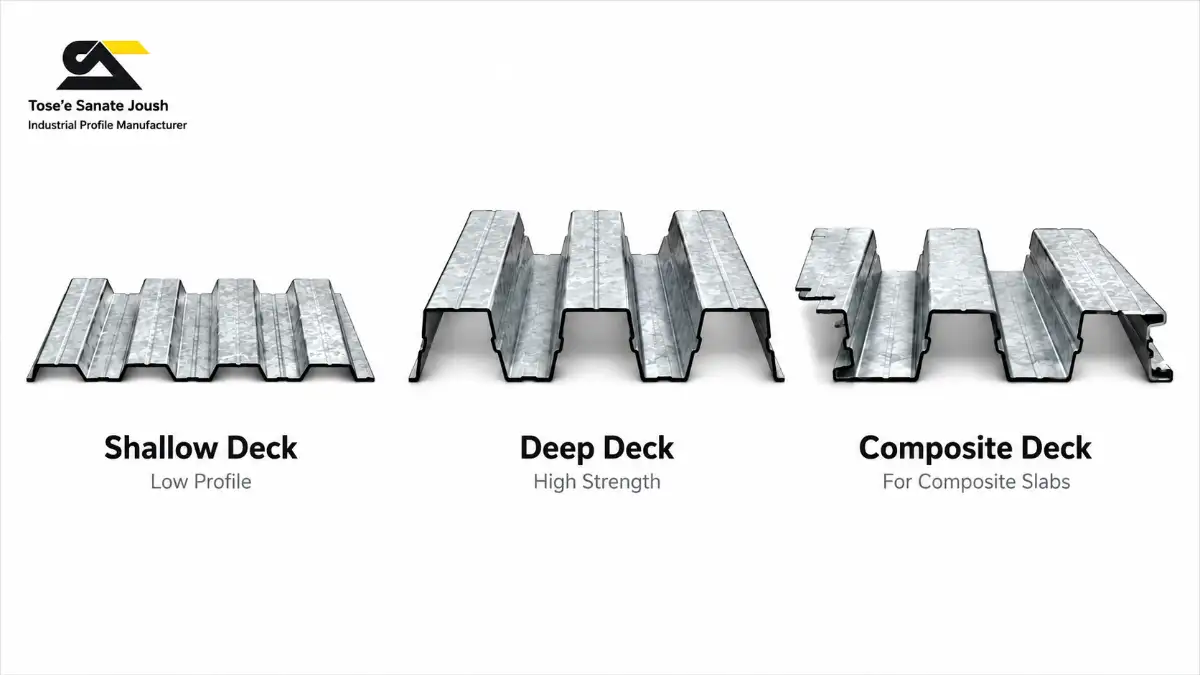
Steel deck profiles can generally be grouped according to cross-sectional shape, rib depth and rib type. Each manufacturer may use different product names, but from a technical point of view, understanding the general profile form is more important.
Open Trapezoidal Profile
The open trapezoidal profile is one of the most common forms used in steel deck sheets. In this type of profile, the ribs have an open trapezoidal shape. The top flange, sloped webs and valleys between the ribs create the repeating cross-sectional pattern.
This profile is usually suitable for industrial production, panel overlap and fast installation. However, not all trapezoidal profiles are the same. Pitch, depth, top flange width, valley width and embossment details may vary from one product to another.
Among different steel deck profiles, the trapezoidal profile is widely known for composite floor applications because of its common use in building projects.
Shallow Profile
A shallow profile has a lower rib height. This type of profile is usually considered where spans are shorter or where a deeper cross-section is not required.
A shallow profile may help control concrete volume and make handling easier in some projects, but it must be selected based on the structural drawings and product datasheet. If the secondary beam spacing or construction-stage loads are higher, a shallow profile may not meet the project requirements.
When comparing steel deck profiles, a shallow profile should not be selected only because it is lighter. Building use, span, concrete thickness and site conditions must be checked together.
Deep Profile
A deep profile has ribs with greater height. Increasing profile depth can affect section stiffness, sheet behavior during concreting and the ability to span longer distances. However, this effect also depends on sheet thickness, web shape and the product datasheet.
In deeper profiles, more space is usually created for concrete to fill the ribs. The internal rib space and shear stud placement also become more important.
Therefore, a deeper profile is not automatically better. When reviewing different steel deck profiles, it must be checked whether the greater depth matches the real project requirements or only increases concrete consumption and system weight.
Dovetail Profile
A dovetail profile has a more closed shape with re-entrant corners in the cross-section. This profile is different from an open trapezoidal profile and is used in some special floor or roof systems.
Because of its different cross-sectional form, the load tables, overlap details and connection requirements for this profile must be checked strictly according to the manufacturer’s specifications.
Dovetail profiles are not used in every common steel deck floor project, but knowing this type helps make the difference between standard open profiles and more specialized systems clearer.
Special, Cellular or Acoustic Profiles
In some systems, a profiled sheet may be combined with a flat sheet or another layer to create a cellular section. Some profiles are also designed for acoustic applications or floor and roof systems with specific sound requirements.
These profile groups are not always used in ordinary building projects, but they show that steel deck profiles are not limited to one fixed shape. Depending on project requirements, more specialized profiles may also be considered.
How Is a Steel Deck Profile Produced?
A steel deck profile is usually produced on a roll forming line. In this process, a galvanized steel strip continuously passes through a series of rollers, and each stage forms part of the final rib shape.
The pitch, depth and overall profile geometry are the result of roller design and production line adjustment. If the line settings, raw sheet quality or final inspection are not correct, profile consistency may be affected.
For this reason, producing consistent steel deck profiles depends on accurate control of the roll forming line. This process is explained in more detail in the article on steel deck roll forming.
How Does Profile Pitch Affect Installation?
Pitch determines the spacing at which ribs repeat across the sheet width. This affects the number of ribs within the effective cover width, the overlap between sheets and potential shear stud locations.
On beams where the ribs are perpendicular to the beam, rib spacing can affect where the sheet crosses the beam and where connections may be placed.
However, pitch alone is not a selection criterion. When comparing steel deck profiles, pitch should be reviewed together with depth, thickness, top flange width, valley width and the technical datasheet.
How Does Profile Depth Affect Sheet Performance?
Profile depth is one of the important geometric properties of the cross-section. In general, increasing depth can affect stiffness and bending behavior, but the final performance does not depend only on depth.
To evaluate profile performance, sheet thickness, web shape, top flange width, valley width, steel grade, effective cover width, span, support conditions and construction-stage loading must also be checked.
As a result, when selecting from different steel deck profiles, the decision should not be based only on choosing the deepest rib. A profile with lower depth may be fully suitable for a specific span and project condition.
Does Larger Pitch or Greater Depth Mean a Better Sheet?
No. Larger pitch or greater depth does not automatically mean that the sheet is better.
A larger pitch may reduce the number of ribs across the sheet width and affect connection locations. A smaller pitch is not automatically better either, because the complete cross-sectional shape, flange widths, valley widths and real sheet capacity must be checked.
Greater depth can also have advantages, but it may change concrete volume, installation details, shear stud layout and final system weight.
Therefore, the correct question is not “Which pitch or depth is better?” The correct question is: “Which steel deck profile is more compatible with the drawings, span, loading and site conditions of this project?”
Relationship Between Profile Type and Shear Stud Layout
In steel deck floors, shear studs are usually used to create shear connection between the concrete slab and the steel beam. Shear stud location depends on deck direction, rib shape, space inside the rib and where the sheet crosses the beam.
If the deck ribs are perpendicular to the beam, shear studs are usually installed in the rib areas that cross over the beam. If the ribs are parallel to the beam, the geometric and installation conditions will be different.
For this reason, when comparing different steel deck profiles, the available welding space for shear studs must be checked. For the relationship between connector quantity and deck arrangement, read the article on the number of steel deck shear studs per square metre.
Relationship Between Profile Shape, Concrete Thickness and Concrete Consumption
The profile shape affects the volume of concrete inside the ribs. Two sheets with the same steel thickness but different depth and pitch may require different amounts of concrete.
In deeper profiles, more space is usually created for concrete. However, the exact concrete volume depends on the full cross-sectional geometry, not only on depth.
Therefore, when comparing steel deck profiles, concrete consumption should be calculated from the actual profile cross-section and the concrete thickness above the sheet. Using one fixed value for all profiles can create errors in quantity take-off.
Difference Between Steel Deck Profiles and Ordinary Formed Sheets
Not every formed or corrugated sheet is a suitable steel deck sheet for a composite floor system. Steel deck sheets must be evaluated based on structural use, profile type, thickness, coating, effective cover width and technical datasheet.
In a steel deck floor system, the sheet acts as permanent formwork and must support fresh concrete and temporary construction loads during execution. Its profile shape is also related to shear stud installation, concreting and slab performance.
Therefore, a profiled sheet should not be used as a substitute for steel decking in building projects only because it looks similar.
What Should Be Checked When Selecting a Steel Deck Profile?
To make the right choice among different steel deck profiles, several specifications must be reviewed together. The most important items include profile type, pitch, depth, sheet thickness, effective cover width, galvanized coating quality, span, loading, concrete thickness, deck direction and shear stud installation method.
At the time of purchase or approval, the profile drawing should be checked against the product datasheet. If a trade name or profile code is provided, the decision should not be based only on the name. The actual cross-sectional dimensions must also be reviewed.
Common Mistakes in Comparing Steel Deck Profiles
One common mistake is comparing two profiles only by sheet thickness. Thickness is important, but pitch, depth and cross-sectional shape also affect performance.
The second mistake is confusing pitch with depth. Pitch is measured horizontally, while profile depth or height is measured vertically.
The third mistake is judging only by appearance. Two sheets may look similar, but their effective cover width, web angle or load table may be different.
The fourth mistake is ignoring the rib direction relative to the beam. This can affect shear stud layout and connection execution conditions.