
What Does Steel Deck Sheet Thickness Actually Mean?
Steel deck sheet thickness refers to the thickness of the galvanized steel sheet itself. In other words, it is the distance between the two surfaces of the steel sheet, without considering the rib height or the profile pitch.
This thickness is different from the profile height or rib depth. Two sheets may have the same thickness but perform differently because of differences in profile height, pitch, top flange width or rib shape.
Sheet thickness is also not the same as effective cover width. Effective cover width is related to how adjacent panels overlap and how much width each sheet covers after installation.
Difference Between Thickness, Pitch and Rib Height
One of the common mistakes in ordering or inspecting steel deck sheets is confusing thickness with pitch or profile height. These are three separate properties.
Property | Definition | Main Effect |
Sheet thickness | Thickness of the galvanized steel sheet itself | Weight, local stiffness and construction-stage behavior |
Sheet pitch | Repeating distance of the ribs across the sheet width | Number of ribs, layout and profile geometry |
Profile height | Vertical distance between the lowest and highest parts of the rib | Bending capacity, span behavior and section shape |
Effective cover width | Width covered by each panel after installation | Quantity take-off and number of sheets required |
For example, when a sheet is described as 1 mm thick, this refers to the steel sheet thickness, not the rib height. To understand the difference between pitch, rib height and rib width, read the article on steel deck pitch.
How Does Sheet Thickness Affect Steel Deck Performance?
Effect on Sheet Weight
As the sheet thickness increases, the weight per square metre also increases. This affects transportation, loading, site handling and the dead load of the floor system.
However, more weight does not always mean a better choice. If the selected thickness is higher than what the project actually requires, the cost and dead load may increase without creating a meaningful performance benefit.
Effect on Temporary Deflection and Deformation
During construction, before the concrete hardens, the steel deck sheet acts as permanent formwork. At this stage, the sheet must support its own weight, fresh concrete, construction workers and temporary site loads.
A thicker sheet usually provides better stiffness and resistance during construction. However, this also depends on the profile shape, rib height and spacing between secondary beams. Therefore, selecting thickness without considering span is not technically accurate.
Effect on Allowable Construction Span
The greater the distance between secondary beams, the more important the sheet’s ability to span becomes. In such conditions, sheet thickness, profile height and cross-sectional shape are all important.
However, increasing thickness alone cannot solve every span problem. In some cases, changing the profile type or reducing the spacing between secondary beams may be a better solution than increasing the sheet thickness.
Effect on Handling and Installation Quality
Thinner sheets may be more likely to experience local crushing or deformation during handling, storage or site movement. Thicker sheets usually provide better construction stability, but they also increase weight and cost.
The correct choice is a balance between site safety, cost, weight and compliance with structural calculations.
Effect on Shear Stud Welding and Layout
In steel deck floors, shear studs are usually welded through the deck sheet onto the top flange of the steel beam. Sheet thickness, together with proper contact between the sheet and the beam, surface cleanliness and welding machine settings, can affect weld execution quality.
However, shear stud performance does not depend only on sheet thickness. Stud type, diameter, length, weld quality, beam surface condition and stud location within the profile are also important. For more details, refer to the guide on steel deck shear stud installation.
Is a Thicker Steel Deck Sheet Always Better?
No. A thicker steel deck sheet is not always the better option. Thickness must match the project requirements.
If the selected sheet is too thin, it may lead to excessive deflection, vibration, deformation or vulnerability during construction. If it is too thick, it may increase the dead load and project cost and may not be economically efficient.
The correct selection is made when sheet thickness is coordinated with span, profile type, concrete thickness, loading, building use and structural drawings.
Main Factors in Selecting Steel Deck Sheet Thickness
1. Spacing Between Secondary Beams
One of the most important factors is the spacing between secondary beams. As this spacing increases, the sheet is subjected to higher bending during concreting, and thickness selection becomes more critical.
For larger spans, thickness alone is not enough. Rib height, profile geometry and support conditions must also be checked.
2. Type and Geometry of the Profile
Two sheets with the same thickness will not behave the same if their profiles are different. Rib height, pitch, top flange width, valley width and web angle all affect the section properties.
The sheet profile is formed during production as the flat strip passes through a series of rollers. This process is explained in more detail in the article on steel deck roll forming.
3. Concrete Thickness and Weight
Fresh concrete applies a significant load to the sheet during construction. The greater the concrete thickness above the steel deck, the higher the construction-stage dead load.
Therefore, sheet thickness must be coordinated with concrete slab thickness and the structural drawing details.
4. Temporary Construction Loads
During concreting, workers, pump hoses, equipment, concrete accumulation and site traffic can create temporary loads. The sheet must have sufficient stability during this stage.
For this reason, checking sheet thickness only for the service stage is not enough. The construction stage must also be considered.
5. Building Use
The floor loading in a residential building, parking structure, commercial building or industrial project is not the same. Building use can affect slab thickness, beam spacing and sheet specifications.
Steel deck sheet thickness should be selected as part of the complete floor system, not as an isolated number.
6. Galvanized Coating and Environmental Conditions
Steel deck sheets are usually manufactured from galvanized steel sheets. The quality of the galvanized coating, storage conditions, site humidity and exposure time in open air can affect surface durability and quality.
In humid environments or projects where the sheets remain exposed to weather for a longer time, checking the surface and coating condition becomes more important.
7. Project Drawings and Product Datasheet
No general number should replace the approved structural drawings and manufacturer datasheet. Sheet thickness, profile type, effective cover width, pitch and sheet length must be checked according to the technical documents of the project.
If the delivered sheet thickness differs from the drawing or order, the issue must be reviewed and approved before installation.
Nominal Thickness vs. Actual Thickness
In the market, sheets are usually identified by nominal thicknesses, such as 0.9 mm or 1.0 mm. However, the actual thickness should be measured with suitable tools and compared with the permitted product tolerance.
It should also be clear whether the stated number refers to the base steel thickness or the total thickness including coating. In sensitive projects, this should be checked using the product datasheet or certificate.
At delivery, it is better to measure the thickness of several sheet samples at different locations. Measuring only one point or one panel is not enough to judge the entire shipment.
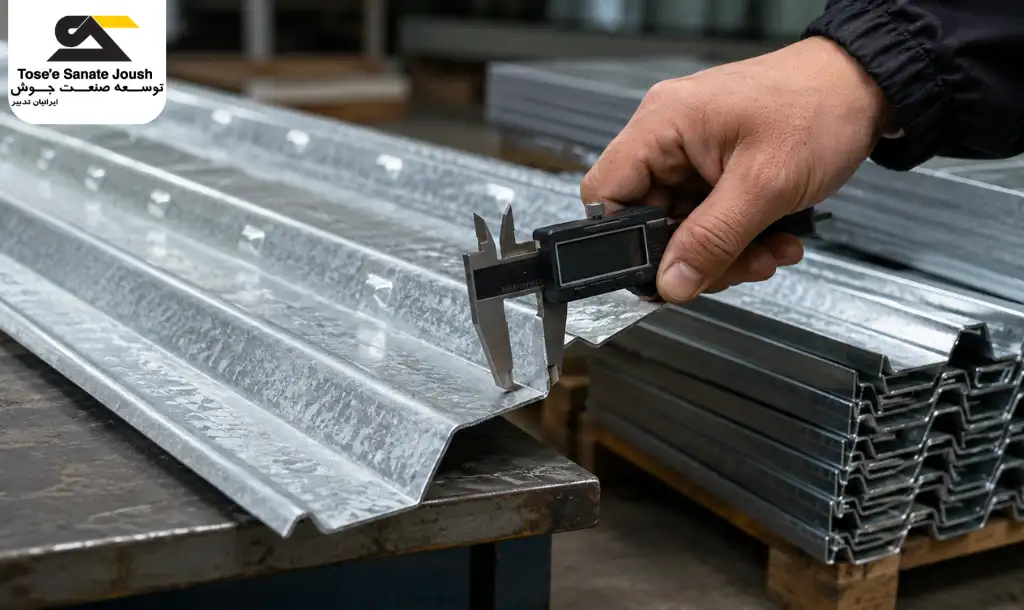
How to Check Steel Deck Sheet Thickness
A caliper or micrometer can be used to check sheet thickness. The measurement point should be clean, sound and free from local crushing.
Measuring damaged edges, severely bent areas or parts affected during transportation may give an incorrect result.
It is better to measure several points on several different panels and compare the results with the thickness stated in the order, invoice, datasheet or project drawing. Minor differences should be evaluated according to the product tolerance.
Should Thickness Be Selected Based on Price?
The price of steel deck sheet depends on thickness, weight, steel type, galvanized coating, dimensions, market conditions and production costs. Greater thickness usually increases weight and price.
However, selecting thickness only to reduce price can be risky. If the sheet is thinner than required, it may cause execution problems, deflection, sheet damage or technical rejection.
The correct approach is to first determine the required thickness based on drawings and technical specifications, and then compare the prices of acceptable options. For product review and price inquiry, the steel deck sheet product page can be used as the commercial path of the article.
Relationship Between Sheet Thickness and Shear Stud Quantity
Sheet thickness does not directly determine the number of shear studs. Shear stud quantity depends on shear connection design, beam length, required shear force, rib direction and the number of studs required in each rib.
However, sheet thickness and profile geometry can affect welding conditions and stud placement. Therefore, in steel deck projects, sheet specifications and connection details must be reviewed together.
For further explanation and estimation, read the article on the number of steel deck shear studs per square metre.
Common Mistakes in Selecting Steel Deck Sheet Thickness
One common mistake is selecting thickness only based on price. In this case, the selected sheet may not match the span or construction conditions of the project.
The second mistake is confusing thickness with profile height. A 1 mm sheet can have a shallow or deep profile, and these two profiles will not perform the same.
The third mistake is comparing two sheets only by thickness. For a technical comparison, pitch, height, effective cover width, profile shape, steel grade, galvanized coating and load tables should also be reviewed.
The fourth mistake is ignoring the construction stage. During concreting, the sheet acts as permanent formwork and must perform properly before the concrete hardens.
What Should Be Checked When Buying or Receiving Steel Deck Sheets?
Before approving the sheets, compare the stated thickness with the order and project drawing. Then check the pitch, profile height, effective cover width and galvanized coating condition.
The sheets should be sound, without severe crushing, unusual twisting or significant corrosion. It is also better to inspect several panels from different parts of the shipment, not only the first sheet in the package.
In projects where the sheets will be used for shear stud welding, the contact area between the sheet and the beam, rib direction and compliance with the stud layout drawing must also be checked.