
Roll forming is a continuous sheet-forming method used to manufacture long sections with a consistent cross-sectional profile. In steel deck sheet production, a flat metal strip passes through several sets of rollers. These rollers gradually form the ribs, flutes, edges and final profile of the sheet.
The quality of the roll forming process is not limited to the appearance of the ribs. The actual sheet thickness, effective cover width, dimensional consistency, condition of the galvanized coating and cutting accuracy can all affect how the sheets are laid and how they perform in a construction project.
After installation, profiled steel sheets interact with steel beams, fasteners, concrete and other components of the floor or roof system. Their final dimensions and properties must therefore comply with the approved structural drawings and project execution requirements. For a broader understanding of the complete system, refer to the steel deck flooring guide.
In simple terms, roll forming is a continuous cold-forming process in which a flat metal strip is progressively bent by passing it through multiple roller stands until it becomes a uniform longitudinal profile, such as a steel deck sheet.
What Is Roll Forming and How Is It Performed?
In roll forming, the sheet is shaped at normal ambient temperature without generally heating the material. An uncoiled metal strip enters a series of roller stands, and each stand produces only part of the required angle or curvature.
As a result, the total strain and deformation are distributed over several forming stages, allowing the final cross-section to be produced continuously and with greater dimensional consistency.
The Steel Deck Institute describes a typical steel deck production line as consisting of an uncoiler and a series of progressive forming tools. Once the required profile has been formed, the continuous strip is cut to the specified length by a cutting unit. Actual profile dimensions and edge details may vary between manufacturers and products.
Roll Forming vs. Press Brake Bending
In press brake bending, deformation is normally produced at one or more specific points by a die and press movement. This method is generally more flexible for individual components, limited lengths and low- to medium-volume production.
In roll forming, the sheet moves continuously, while the cross-sectional shape is developed through a sequence of forming stands. The process is better suited to long products that require a uniform profile along the entire sheet. However, the roller design and machine settings must be accurately matched to the sheet thickness and product geometry.
Comparison Criterion | Roll Forming | Press Brake Bending |
Production method | Progressive forming through multiple roller stands | Localized bending with a press and die |
Part length | Suitable for long sections | Limited by the machine and tooling |
Production volume | Suitable for continuous, high-volume production | More suitable for smaller production runs |
Profile consistency | High when the line is correctly adjusted | Depends on the repeatability of each operation |
Production speed | High after line setup | Depends on the number of bends |
Typical applications | Steel deck, longitudinal profiles and corrugated sheets | Individual components and localized bends |
Steel Deck Roll Forming Process
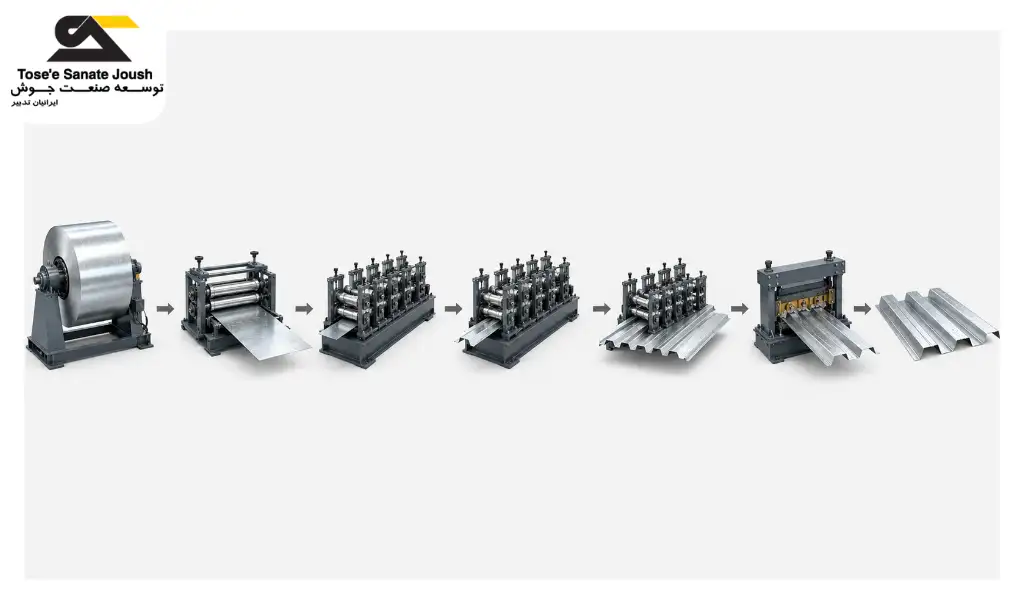
Selecting and Preparing the Steel Coil
The process begins by selecting a coil whose steel grade, thickness, width and coating comply with the order specifications.
For galvanized sheets, the surface should be checked before entering the production line. Active corrosion, deep scratches, edge dents and surface contamination should not be present.
The coil width must be compatible with the developed sheet width and profile geometry. An unsuitable coil width may reduce the effective cover width, prevent the side-lap edges from forming correctly or increase material waste.
The final sheet thickness and coating type must be verified against the approved drawings, purchase documents and applicable project standards.
Uncoiling and Feeding the Sheet into the Line
The coil is mounted on an uncoiler, where the sheet is released under controlled tension. Controlling the uncoiling speed is important because sudden release may create impact loads, irregular loops or unstable sheet movement at the line entrance.
The entry guide aligns the sheet with the centreline of the roll forming machine. Off-centre feeding can cause lateral movement, unequal edge formation or longitudinal twisting during later stages.
Straightening and Aligning the Sheet
After uncoiling, the sheet may retain some of the curvature caused by being wound around the coil. A straightening or levelling unit passes the sheet between adjusted rollers to reduce this initial curvature and waviness.
Improper straightening can make the sheet unstable as it enters the forming stands. Side guides must also hold the sheet in position without causing scratches or concentrated pressure on the surface.
Passing the Sheet Through the Roller Stands
The roller stands are the central components of the roll forming process. The first stands create the initial bends, while the following stands gradually bring the angle, depth and position of each part of the profile closer to its final dimensions.
No individual stand should create the entire deformation suddenly. Excessive pressure or an unsuitable forming sequence may cause wrinkling, edge stretching, cracking at bends or damage to the protective coating.
The number and arrangement of the forming stands depend on the profile geometry, sheet thickness and formability of the material.
Forming the Steel Deck Pitch and Ribs
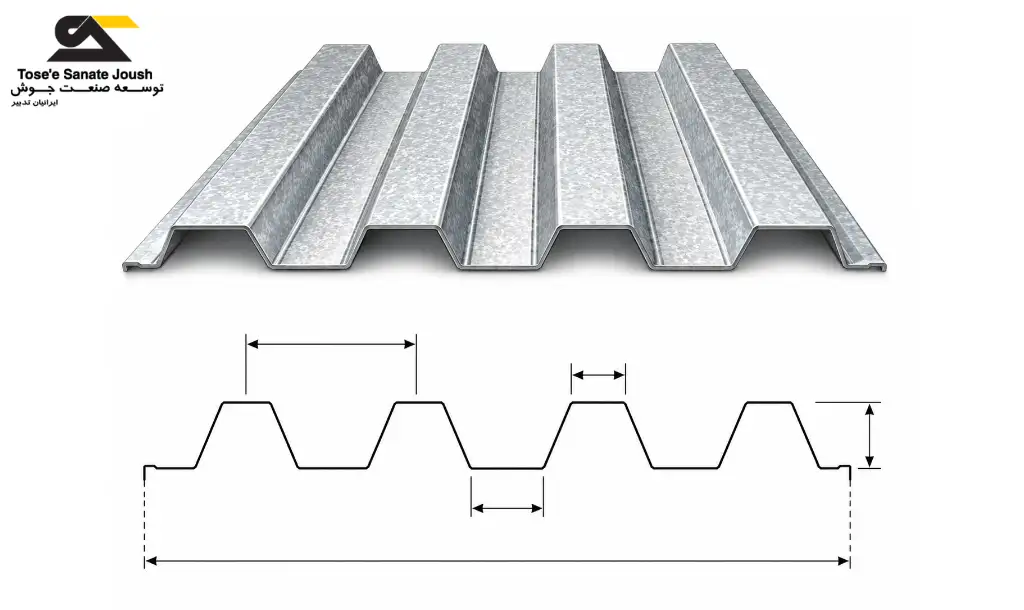
Steel deck pitch is the distance between one rib or flute and the corresponding point on the next repeating rib. Rib height, top and bottom flange widths, web angles and side-lap geometry are also important parts of the profile.
The effective cover width is not the same as the original flat coil width. Part of the material width is used to form the webs, flutes and side-lap edges.
Deck pitch, rib height and effective cover width must be checked against the approved drawing and product specifications. A single standard dimension cannot be assumed for all steel deck profiles.
Cutting the Sheet to the Required Length
Once the profile is complete, the length-measuring system determines when the blade or cut-off unit should operate. Cutting may be performed after stopping the line or by using a system designed to cut while production continues.
The sheet ends should be square within the specified tolerance. An angled cut or incorrect sheet length can make installation more difficult, create gaps over the supports, cause interference between sheets and increase material waste.
Quality Control, Packaging and Delivery
During final inspection, the sheet length, thickness, pitch, rib height, effective cover width and cross-sectional consistency should be checked.
Warping, twisting, edge condition, surface scratches and coating damage must also be inspected and recorded.
Approved sheets should be packed in a way that protects both the edges and the galvanized coating during handling and transportation. Package information must correspond to the order, cutting schedule and intended installation area.
What Factors Affect Roll Forming Quality?
Actual Sheet Thickness
The roller gap is adjusted according to sheet thickness. A difference between the actual thickness and the thickness used for machine setup can affect forming pressure, bend radius, final width and springback.
The actual thickness should therefore be measured before production and verified again during final quality control.
Deck Pitch and Rib Height
The deck pitch and rib height must comply with the structural drawings and the selected construction system.
A dimensional difference can change the effective cover width, the position of the sheet over the supporting beams and the fit between adjacent sheets.
Coil and Galvanized Coating Quality
The coil surface should be free from active corrosion, contamination, deep scratches and damaged edges.
During forming, the galvanized coating should not peel, crack or suffer excessive scratching because of incorrect pressure or defective contact between the sheet and the rollers.
Roller Alignment and Line Speed
The alignment of the stands, roller clearances and pressure distribution all affect the final profile.
A production speed that is not compatible with the line condition may increase lateral deviation, waviness, twisting or dimensional instability.
Cutting Accuracy and Sheet Length
Incorrect sheet length or an angled end cut can disrupt deck placement and may reduce the required bearing area.
Final acceptance of sheet length and end condition should be based on the order tolerances and approved installation drawings.
Common Roll Forming Defects
Longitudinal bowing or twisting may occur when the forces applied to the two sides of the sheet are not balanced.
Differences in pitch or effective cover width are often related to roller adjustment, sheet position or material variation. Wrinkling and cracking may result from excessive localized pressure, an unsuitable bending sequence or limited sheet formability.
Damage to the galvanized coating should be distinguished from minor superficial marks. Dimensional differences between the beginning and end of a sheet may indicate line instability, sheet slippage or incorrectly adjusted guides.
Observed Problem | Possible Cause | Inspection and Control Method |
Longitudinal bowing | Unequal pressure between roller stands | Place the sheet on a flat surface and readjust the stands |
Lateral deviation | Off-centre sheet entry | Inspect the entry guide and line centreline |
Pitch variation | Incorrect adjustment or worn rollers | Measure several cross-sections along the sheet |
Effective width variation | Unequal sheet tension | Compare the width at the beginning, middle and end |
Wrinkling or waviness | Excessive pressure or unsuitable forming sequence | Review the progressive forming stages |
Cracking at bends | Insufficient bend radius or poor formability | Closely inspect the bend areas |
Coating damage | Incorrect pressure or roller contact | Perform visual inspection and check roller surfaces |
Angled end cut | Incorrect blade adjustment or poor sheet support | Measure sheet diagonals and check squareness |
How Does Roll Forming Affect Shear Stud Installation?
The sheet geometry, the position of the ribs relative to the beam and the available flute width can affect both shear stud positioning and access for the stud welding gun.
Steel Deck Institute guidance also indicates that restricted flute openings may make certain fastening or welding operations more difficult. The selected steel deck shear stud specifications must therefore be coordinated with the structural details and installation method.
The deck pitch and rib direction affect the number of available stud positions along a beam. However, the final number and arrangement of shear studs must always be taken from the approved structural drawings.
Using a general figure instead of the project drawings is not technically correct. For initial estimation, refer to the method for calculating the number of shear studs per square metre, together with the specific project requirements.
In through-deck stud welding, sheet thickness, surface coating, full contact between the deck and beam flange, and the presence of moisture or contamination can affect weld formation.
The stud welding machine parameters should be selected only after evaluating actual site conditions and carrying out preliminary test welds. Further details can be found in the guide to stud welding machine settings.
Recent studies also indicate that rib direction and deck orientation can affect connector and composite beam behaviour. However, the results of one laboratory test should not be directly applied to every project.
Connector acceptance must be based on the specified shear stud inspection and weld testing procedures.
What Determines the Cost of Steel Deck Roll Forming?
The final cost depends on the steel type and current material price, sheet thickness, order weight, coil width and profile complexity.
Profiles requiring more forming stands, more precise adjustment or complex side-lap details may require additional setup and production time.
Sheet length, cutting method, order quantity, packaging, loading requirements and transportation distance also affect the final price.
A reliable quotation should be based on confirmed technical specifications, the actual order weight and the agreed delivery conditions.
Relationship Between Roll Forming and Steel Deck Components
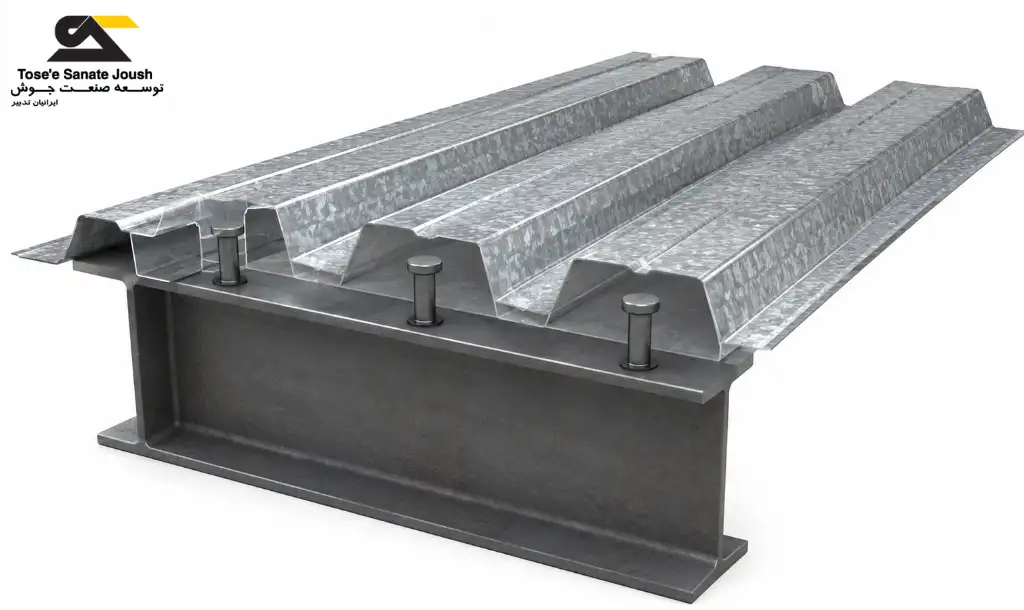
A roll-formed steel deck sheet serves as permanent formwork for concrete and forms part of the floor or roof system. However, the sheet alone does not determine the complete structural performance of the system.
Concrete, reinforcement and sheet specifications must be coordinated in accordance with the structural design.
Shear studs transfer forces between the steel beam and the composite concrete slab. The required site sequence and connection details should be reviewed separately in the guide to steel deck shear stud installation.
Flashings and edge trims are used to close the deck edges and openings. Powder-actuated fasteners or other approved connectors may be used to secure the sheets, depending on the project drawings.
The type and spacing of these connections must be determined by the structural designer and should not be selected only on the basis of the apparent sheet thickness.
The stud welding machine must also be compatible with the stud type, power supply, cable length and surface condition.
Reviewing completed shear stud and stud welding projects can be useful for understanding practical site limitations, but it cannot replace project-specific design, inspection or testing.