
Shear studs are one of the most important components in composite steel structures, transferring shear forces between the steel beam and the concrete slab. However, the performance of a shear stud connection depends not only on the quality of the stud itself but also on the accuracy of the welding process, equipment settings, surface preparation, and inspection procedures.
Shear stud welding inspection is a systematic process used to verify that welded studs meet project requirements and provide reliable structural performance. This process includes checking stud specifications, ceramic ferrule condition, welding parameters, visual inspection of completed welds, production tests, and additional testing when required.
It is important to understand that shear stud inspection is not limited to a single test. The bend test is only one part of the quality control process. A complete inspection program evaluates the entire welding procedure, from preparation before welding to final documentation and acceptance of completed connections.
This guide explains the main inspection steps, testing methods, and quality control requirements for shear stud welding in steel construction projects.
What Is Shear Stud Welding Inspection?
Shear stud welding inspection is the process of evaluating welded shear studs to ensure that the connection between the stud and the steel base material meets the required quality standards.
A proper inspection program usually covers:
- Stud material and dimensions
- Ceramic ferrule condition
- Welding equipment settings
- Surface preparation before welding
- Welding procedure qualification
- Visual inspection of weld collars
- Production testing
- Repair and replacement procedures
- Final quality documentation
The exact inspection requirements depend on the project specifications, welding procedures, and applicable standards such as AWS D1.1, ISO 14555, and ISO 13918.
Inspection Before Shear Stud Welding
Quality control begins before the welding operation starts. Many welding problems can be prevented by checking materials, equipment, and working conditions in advance.
Checking Shear Stud Specifications
Before installation, the following items should be verified:
- Stud diameter and length according to drawings
- Material specifications
- Product certificates when required
- Compatibility with the welding equipment and procedure
The stud dimensions and mechanical properties should comply with the applicable project requirements and relevant standards.
Inspection of Ceramic Ferrules
Ceramic ferrules play an important role in stud welding by controlling the weld pool and protecting the arc area.
Before use, the ferrules should be checked for:
- Correct size compatibility
- Cracks or physical damage
- Moisture exposure
- Proper storage condition
A damaged or wet ceramic ferrule can affect weld formation and reduce connection quality.
Surface Preparation and Base Material Inspection
The welding area must be properly prepared before stud installation.
Important checks include:
- Removing excessive rust, oil, paint, moisture, and contaminants
- Ensuring proper contact between the stud and steel surface
- Checking deck condition in through-deck welding applications
Poor surface conditions can reduce weld quality and create incomplete fusion.
Welding Equipment and Parameter Control
The welding machine settings have a direct impact on stud connection quality.
Important parameters include:
- Welding current
- Welding time
- Lift and plunge settings
- Cable and grounding conditions
- Equipment calibration
These parameters should be controlled according to the approved Welding Procedure Specification (WPS) and project requirements.
Using fixed values for all projects is not recommended because stud diameter, equipment type, base material, and site conditions can affect the required settings.
Production Setup Test for Shear Stud Welding
Before large-scale production begins, the welding setup should be verified.
According to AWS D1.1 requirements, production setup tests may include testing initial studs after setup changes or at the beginning of production. These test studs are visually inspected and may be subjected to bend testing to confirm proper welding performance.
The purpose of this test is to verify that:
- Welding parameters are correctly adjusted
- The equipment is functioning properly
- The welding procedure produces acceptable connections
Setup testing should not be confused with routine inspection of every welded stud.
Visual Inspection of Shear Stud Welds
Visual inspection is the primary quality control method after welding.
During inspection, the following items should be evaluated:
Weld Collar Formation
A properly welded stud should generally have a consistent weld collar around the base.
Inspectors should check for:
- Incomplete weld collar
- Visible cracks
- Excessive defects
- Abnormal weld appearance
However, acceptance should always be based on the applicable welding standard rather than appearance alone.
Stud Position and Alignment
The inspector should verify:
- Stud location according to drawings
- Proper vertical alignment
- Correct spacing between studs
- No visible damage after welding
Incorrect positioning may affect composite action between steel and concrete.
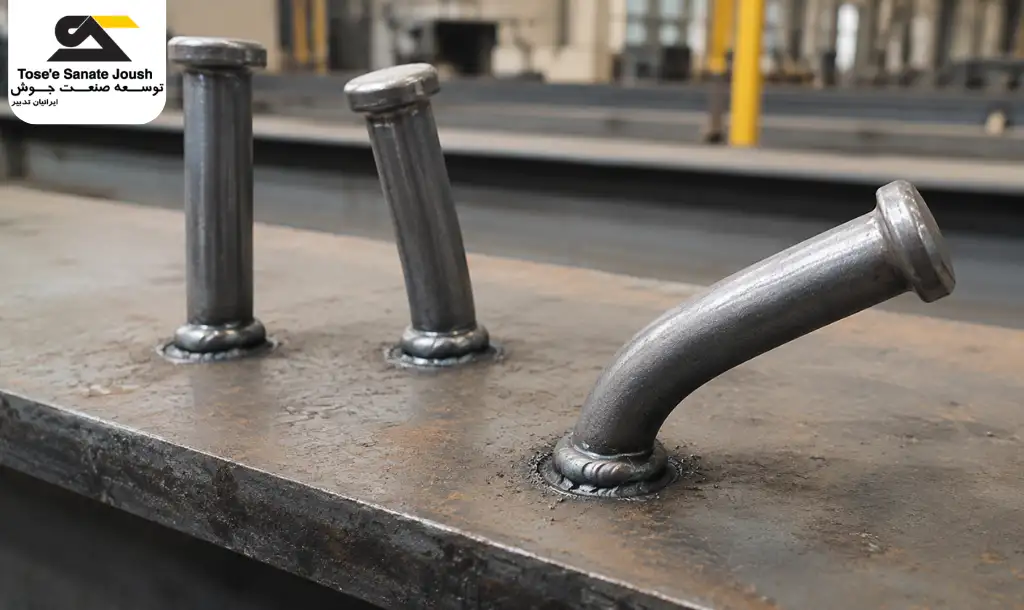
Shear Stud Bend Test
The bend test is a mechanical inspection method used to evaluate the quality and behavior of welded shear studs.
However, the bend test is not the only inspection method and should be applied according to the purpose of the test and project requirements.
For example, production setup tests and evaluation of questionable welds may involve different procedures and acceptance criteria.
Detailed information about:
- Bend test procedure
- Testing equipment
- Acceptance criteria
- Common failure modes
is covered in the dedicated article:
Shear Stud Bend Test: Procedure, Acceptance Criteria, and Common Failures
Other Shear Stud Testing Methods
Different testing methods may be used depending on project requirements.
Testing Method | Purpose |
Visual Inspection | Checking weld appearance and general connection quality |
Bend Test | Evaluating weld performance through controlled bending |
Tensile Test | Measuring tensile capacity of stud connections |
Macro Examination | Evaluating weld penetration and fusion in cross-section |
Push-Out Test | Studying shear resistance, slip behavior, and composite connection performance |
The Push-Out Test is mainly used for research, qualification, and performance evaluation rather than routine site inspection of every welded stud.
What Happens If a Shear Stud Fails Inspection?
When a welded stud does not meet acceptance requirements, the first step is identifying the possible cause.
Possible causes include:
- Incorrect welding parameters
- Poor surface preparation
- Damaged ceramic ferrule
- Equipment problems
- Incorrect installation procedure
The failed area should be marked and evaluated according to the approved quality control procedure.
Repair or replacement should be performed according to:
- Project specifications
- Approved WPS
- Applicable welding standard
- Engineer or inspector approval
A general repair method should not be applied to every project because repair requirements depend on the specific connection and governing standard.
Shear Stud Welding Quality Control Checklist
Inspection Stage | Control Item | Result |
Documentation | Approved drawings, specifications, and WPS available | ☐ Accept ☐ Correct |
Stud Material | Diameter, length, and specifications verified | ☐ Accept ☐ Correct |
Ceramic Ferrule | Correct size, dry, and undamaged | ☐ Accept ☐ Correct |
Surface Condition | Welding area clean and prepared | ☐ Accept ☐ Correct |
Equipment Setup | Welding parameters verified | ☐ Accept ☐ Correct |
Production Test | Initial setup test completed when required | ☐ Accept ☐ Correct |
Visual Inspection | Weld collar and stud condition checked | ☐ Accept ☐ Further Test |
Defective Studs | Repair or replacement performed according to procedure | ☐ Accept ☐ Correct |
Final Records | Inspection results documented | ☐ Complete |
Difference Between Stud Quality Control and Welding Inspection
Stud quality and welding quality are related but not identical.
A high-quality shear stud may still produce a poor connection if:
- Welding parameters are incorrect
- Surface preparation is insufficient
- Equipment settings are unsuitable
Likewise, proper welding cannot compensate for a stud that does not meet required material or dimensional specifications.
Therefore, effective quality control requires both product inspection and welding process control.